
Water everywhere, water without end
Water scratching at the door, trying to get in
Water calling out, calling out my name
Is the water different?
Or are we both the same?
Water ends where life begins
Water wins where my life ends
Water pouring now, far too late to flee
Is the water different?
Or is it part of me?
— Jerod Jarvis
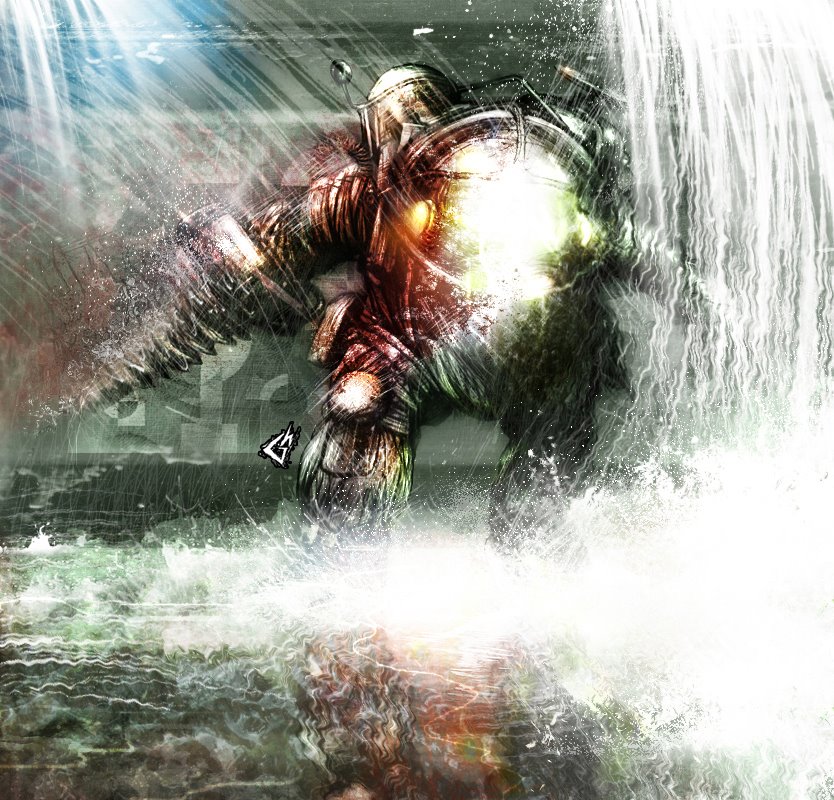 From the moment the game begins, Bioshock makes one thing clear — water is your enemy, and if you’re not careful, it will end up being your tomb.
The game opens with the player seated on an ill-fated airplane, which wastes no time in coming apart at the seams and crashing into the ocean. The air in your lungs holds out just long enough for you to reach the surface, where you’re greeted with what is quite possibly one of the most jaw-dropping scenes in gaming history. Flames cover the water where the plane has spewed fuel and oil; the tail section is slowly sinking beneath the hungry waves ahead of you; a strange tower juts out of the water in the near distance, dark and imposing, but your one chance of escaping a watery death; all of this rendered in absolutely stunning fashion. A few years from now, it is conceivable that the graphical quality of Bioshock may become substandard, but for now, it is quite simply one of the more gorgeous games ever to grace a screen.
After dragging yourself out of the water and shakily gathering your nerves, you slowly move up the stairs towards the door of the tower, still dark and mysterious but welcoming in that it is your only chance of survival. As you step through the doorway, it slams shut behind you and lights flicker on, illuminating a grand interior done up in tasteful art deco style, dominated by the statue of a man and a scarlet banner with the words “No gods or kings — only man” written upon it in gold.
Making your way down the stairway you find a submersible, and while you are perhaps reluctant to venture back into the water, it does seem like the only direction available. Stepping inside and pulling the lever, the door closes and the bulbous device slips down into the depths.
On the way, you’re treated to a short presentation that seems to have been intended for travelers similar to yourself, albeit those who had arrived in a less disastrous fashion. A man who calls himself Andrew Ryan tells you he grew tired of the world taking from him what he had created … and so instead of submitting, he chose to escape, and build an undersea city — Rapture. A place where the gifted and privileged of the world could practice their art, their science, and their entrepreneurship without the legal and ethical boundaries of the world above to hold them back.
With that introduction, the game sets itself apart from the pack. Most games, particularly first person shooters, are content to hand the player a weapon and point them at the enemy, providing little in the way of story other than, “Go there, shoot them, save the world/planet/universe/human race/your dog.” While there are some that have certainly risen above that drivel, Bioshock is head and shoulders above the rest. There really isn’t another game on the market like it. The only one that really comes anywhere close in terms of depth would be Deus Ex. Issues like utilitarianism, secular humanism, tyranny, human nature, ethics, sanity, morality, and even the existence of God and what place he has in our lives are dealt with either directly or indirectly.
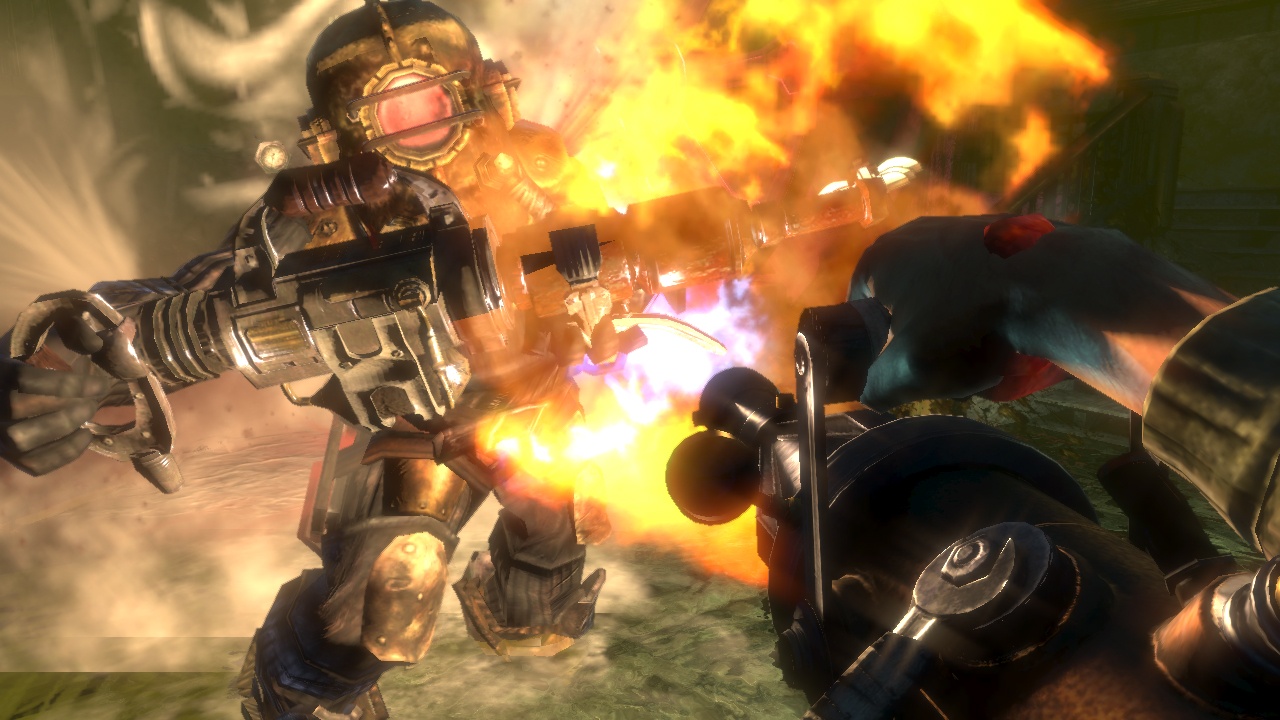 As the submersible surfaces in the station (greeting you with one of the more frightening scenes in any game ever), it becomes clear that Rapture is not the paradise that Andrew Ryan described on your way down, but instead a broken down, leaking, bloody insane asylum. You start to explore the city, discovering the back-story by listening to recordings left by citizens, you begin to uncover what has happened. Without the boundaries of law and morality, what began as a utopia quickly descended into a battleground populated by tyrannical leaders, bloodthirsty rebels, and ordinary people driven violently insane through abuse of genetic modification. You are attacked, toyed with, led along, deceived, and ultimately betrayed in one of the most shocking and brilliant twists a video game has ever offered.
The game’s most controversial points were easily its themes of secular humanism (essentially atheism), and the characters known as the ‘little sisters’. However, having played through this game and spent significant time reflecting upon it, I find that I cannot simply stand back and throw rocks at the game, as some other Christian reviewers have done.
First, the worldview themes. The game is based around the idea that man is the ultimate being, and that freeing him from the bonds of government and religion is the key to securing the future. Andrew Ryan saw himself as a visionary ahead of his time, and those who followed him thought likewise.
However, it is startlingly, shockingly clear upon one’s first entering into Rapture that something went terribly wrong. As the game is explored and the mechanisms of the city’s self-destruction are uncovered, the clues increasingly point towards the one thing that Andrew Ryan and his idealists didn’t factor in — that human nature is innate, not something impressed upon us by outside influences. Human greed, desire for power, and selfishness are not things that religion and government have given us, as Ryan believed. Instead, in seeking to escape those things, he instead created a place where they could truly thrive. The sad truth of the matter is that human beings are fundamentally flawed — greed, selfishness, and pride are built into us. Social conventions can certainly mellow these somewhat, but without a true inner heart change, as Christ offers, humans are humans, wherever they are.
The fascinating aspect of this predicament that the game hints at is found in the gruesome execution scenes of smugglers. Throughout the game, you develop a feeling that Ryan is not fond of smugglers bringing things in from the world above, outside his control, and the crucifixions of these apparent criminals highlight this in tragic fashion. But what is far more interesting is the glimpses into what those smugglers were smuggling: crates of Bibles.
Huh.
So what are the developers saying? That when the world starts collapsing, people turn to religion? I suspect that might have been the point they were trying to make—but their stab in that direction actually illustrates a much stronger, deeper point—when man removes God from the picture, the picture falls apart. Man can only keep up his acting for so long before his true nature begins to reassert himself—and when that happens, when people find themselves at the mercy of their own natures, they turn to things that can change those natures. In this case, in what is either a stroke of genius on the developer’s part or an award-winning case of God using people in spite of themselves, the people of Rapture were turning to the Truth: the Bible.
Most of the Christian reviews, and even some of the secular reviews, seemed to take the execution of Bible-smugglers as a slam against Christianity. And it is — but it’s Andrew Ryan slamming it, not the message of the game. I strongly suspect that this nod to Christianity was unintentional on the part of the developers. Listening to interviews and commentaries leads me to believe they weren’t gunning for anything deeper than man’s apparent need for a religious crutch when things get hard. But if one takes the time to look deeper, a different message can be found.
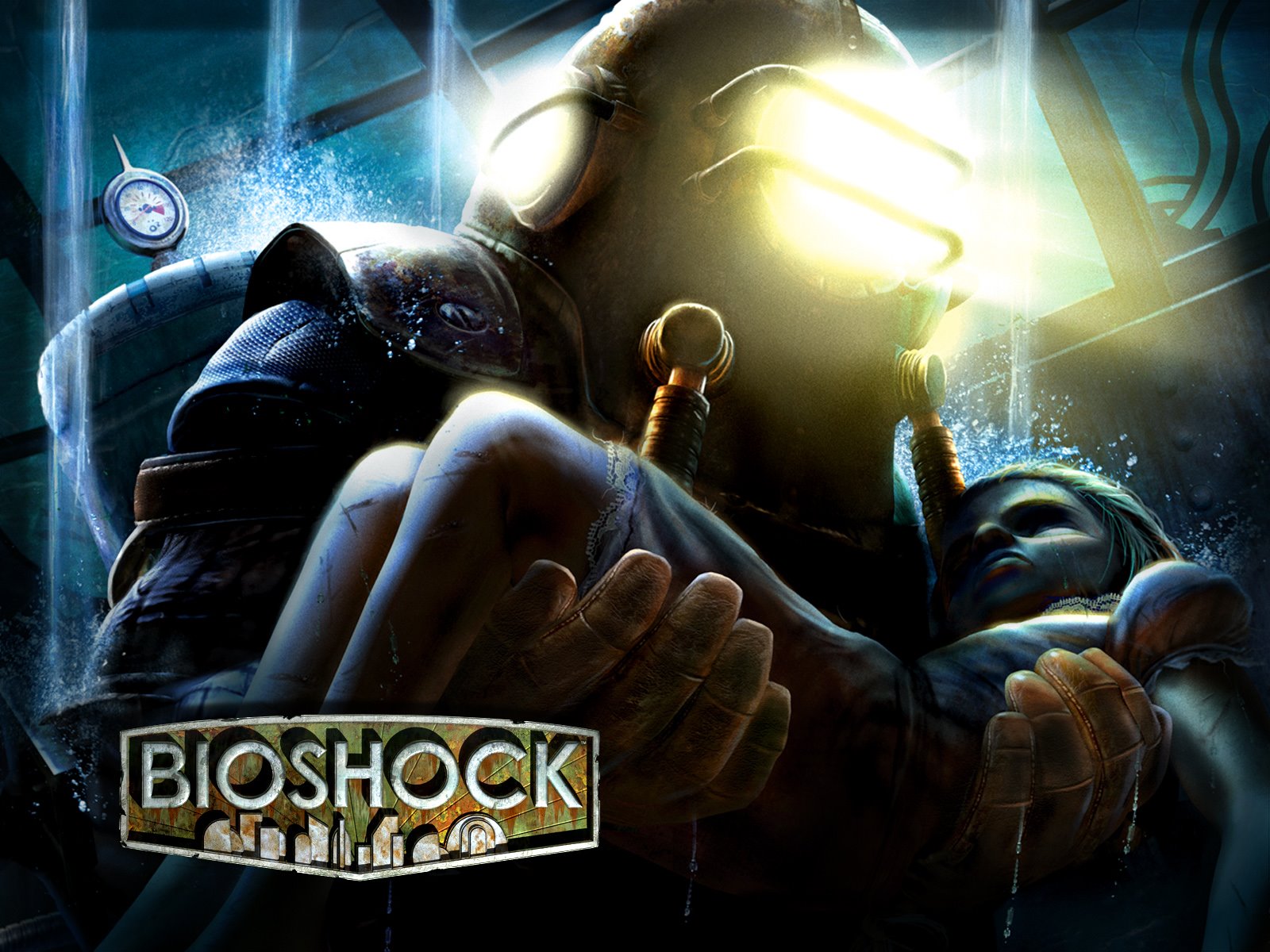 The second point of controversy, the little sisters, is a bit of a different beast, and one which I admittedly can’t defend fully. But I do think there is more to it than what most Christian reviews of this game found.
Without giving too much away, the little sisters are genetically modified young girls who have been programmed to harvest a substance from the dead bodies around Rapture and ingest it, allowing their bodies to refine it and then expel it as Adam, the substance that makes all the genetic modifying in Rapture possible. As the player encounters these characters, they are ultimately faced with a choice — do they harvest the little sister for her precious Adam, which is needed for survival; or do they rescue her, changing her back into a normal little girl?
The catch is this: the first option (harvesting) will net the player more of the much-needed Adam, but it will also kill the little sister. Rescuing will result in less Adam, but the little girl goes free. The idea behind this ethical dilemma was to confront players with a choice — will they stoop to murdering helpless children to serve their own needs? Or will they choose instead the path of self-sacrifice?
Admittedly, this is an incredibly extreme moral dilemma, and begs the question: are gamers so desensitized to this kind of thing that they have to be slapped across the face with a 10-ton ethical choice before they’ll sit up and take notice? I submit that while certainly some are, that isn’t largely the case — but that’s another discussion for another time.
So, ignoring for now the bluntness of the ethical dilemma, the decision before the player remains.
This is where the rock-throwing starting becoming a hailstorm. Christian reviews, and even some secular reviews, decried the game as one that rewarded you for murdering a little girl, citing the fact that the Adam gained for that choice is greater than for saving the little sister. However, once again, those who choose to look a bit deeper will see that there’s more to it than this.
While it is true that killing the little sister results in greater instant gratification, those who commit to the more difficult path of rescuing them will soon find that their rewards are far greater. The little sisters reward the player for his mercy with gifts of Adam and power-ups that far outweigh the reward of murder.
At its heart, then, it’s a face-off between instant and delayed gratification. Choosing the evil choice might seem like it will benefit you more now, but choosing the right thing will reap you greater rewards in the future, even if it makes your life difficult now. And isn’t that how life works? Isn’t that what Christ calls his followers to? Putting others first even at the expense of themselves?
You can lie to your boss about being late for work, and it’ll probably get you out of trouble (instant gratification); but when a co-worker lets slip what really happens, you’ll be in a world more hurt than if you had just told the truth in the first place.
Again, murder of small children is an admittedly blunt tool for illustrating this point, and one that can’t really be completely defended. My point is merely that it does have some modicum of redeeming value, and it certainly is not a reward system that encourages murder, as some have said.
At the end of the day, the player is sent through a series of choices, confrontations, and memorable encounters, all of which serve to shape the outcome of the game. In a city surrounded by cold, merciless water seeping through the cracks to take the lives of the intruders, will the player become part of that system, taking and killing and becoming numb? Or will he resist it, fighting to find a way to right the wrongs even when surrounded by the horrors of evil and attacks on all sides? Will the player join with the water? Or will he fight against it?
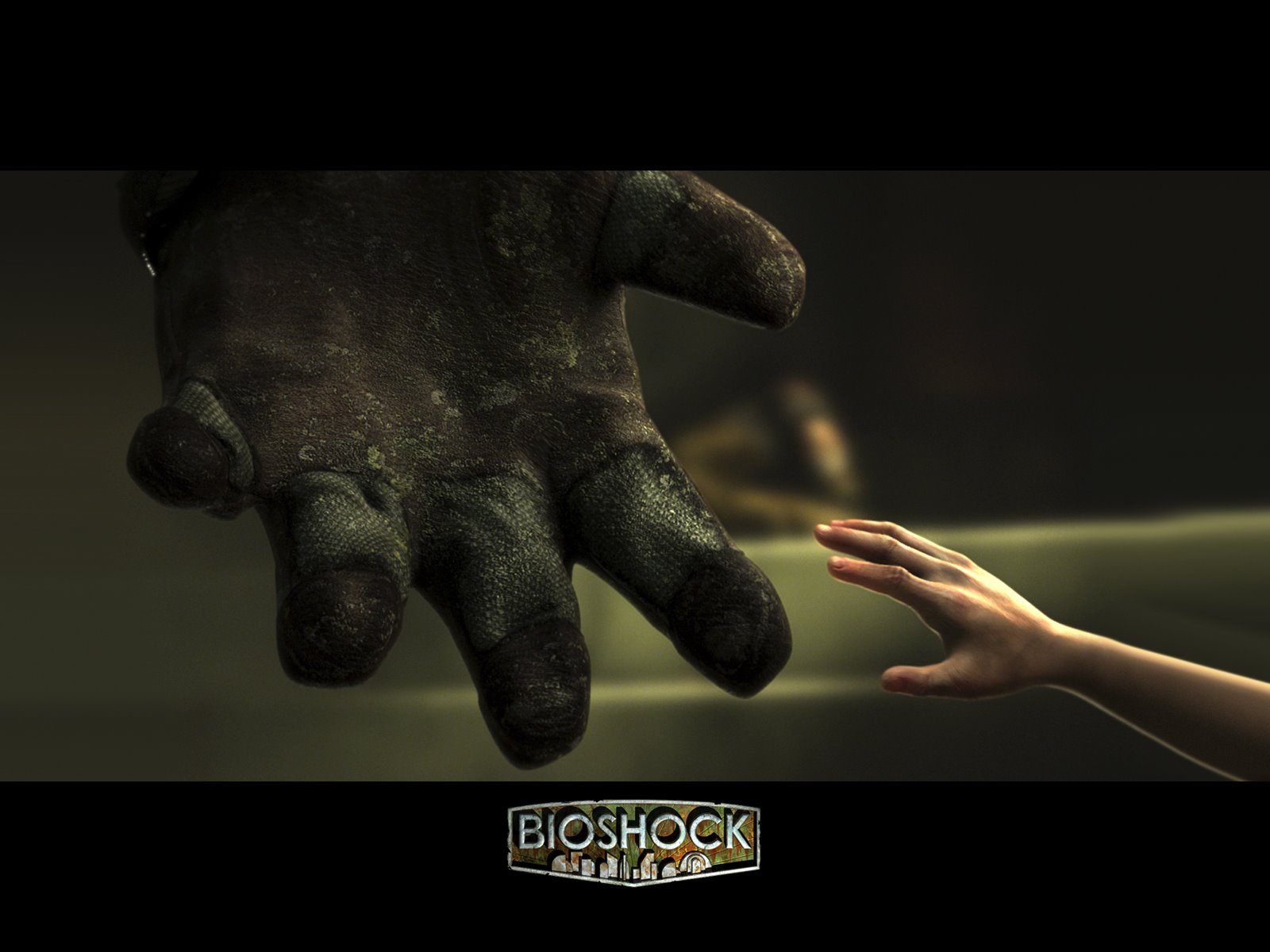 Bioshock is an epic game in every sense of the word. Certainly the issues described above land this game solidly in M-rated territory. Other issues include intense violence throughout, language, and some sexual themes (none of which the player participates in, only finds out about through non-explicit back-story). However, just being an adult doesn’t qualify one to play Bioshock, in my mind. The game’s subtle themes and the issues it presents and deals with can be completely passed over by a player simply looking for a playground in which to shoot things. And to those paying slightly more attention, the surface themes of humanism and atheism, those goals towards which Rapture was reaching can seem like unreached trophies rather than ideals that are fundamentally flawed and doomed from the outset.
Bioshock is a head-trip, and I can only recommend it to those who are willing to put the time into thinking it through and examining what it has to say, and remembering always to check its messages against the Truth — the Bible.
For those who fall into that category, then, I heartily recommend the game as an absolute triumph of the video game medium. Thought-provoking, intellectually disturbing, infuriating, triumphant, eye-opening — these are not terms that are often used to describe games. And while I’d certainly like to see games of this caliber that can be described as uplifting, encouraging, inspiring, and that dabble less with needless M-rated content, this is a step in the right direction for gaming as a medium, and I’m excited to see what the coming years will be like for video games in this post-Bioshock age.
So, with that, I’ll wrap up this exceedingly long post. If you’ve stuck around until now, you’re either a crazy fan of Duality (yes, thank you, you can put your hands down now) or a crazy fan of Bioshock, or you’re just unusually interested in one or the other. Whatever the case, feel free to comment and share your thoughts on this watery epic.
Jerod Jarvis is an independent gaming journalist and founder of Duality Games. He maintains gaming columns for The Washington Times Communities and for The Outpost. When not blogging madly about games, he freelances for the Spokesman-Review in his hometown of Spokane, Washington and attends school at Whitworth University. Check out his presence on Facebook and Twitter to stay up on Duality Games updates and the inside scoop on the gaming news you care about.
 The Blog of Jerod
I actually read it all :PDude, I get so tired of people acting as if Justification was an absolute wrong. Just because you can explain something as okay when it benefits yourself in some way doesn’t make it wrong. And you did a good job of Properly and Biblically justifying this game.The first issue you pointed out was something I assumed would be self explanatory to Christians: When a game has main characters with a bad ideal, but then shows the BAD of that BAD ideal, it’s… lol… good. There’s a movie (Anime) called Steam Boy that I watched, and at first I thought it was okay and filled with people who looked good but were bad (except the main character). But then I realized it was a bunch of different worldviews, showing the bad side of each one, and it was accurate, too! As long as you understand the real happenings, it dosn’t matter if a story doesn’t feature a bunch of “right choices”. Lessons learned often end badly.On your second point, which was a lot less self explanatory in its appropriateness to a Christian, you pulled that off well, too. Just because someone gives you an option to do the wrong thing, doesn’t make them bad. Ever heard of God? LOL.I’m writing a blog for anime. I have only got 4 posts, but its for two things:1. Helping my friends find, understand, and enjoy what they may have missed out on (possibly due to bias).2. Pointing out the Biblical lessons I have discovered.http://www.myanimelist.net/blog/jacfalconWell, that was pretty darn good, and you have a good writing style as well. I’d like to think I am good with the theological stuff, but I know I’m nothing special when it comes to artistic writing, which you have done well with.L8ER
Thanks, Jac. I’ll check out your blog. Anime is definitely something I’ve never gotten into, but also don’t know much about.
I actually moved everything to a blogspot account because its way better ;)http://jacfalcon.blogspot.comAnd I can understand how people get a bad tastes in their mouth for anime with things like Pokemon, YuGiOh, Naruto, and other “Americanized” anime. (Not that I wasn’t a Pokemanz fanboy.)
Lastly, I signed up for feedburner.com and they let you add a gadget to your blog that lets people sign up for email updates. I would sign up and add it if I were you; it helps a lot.