
Tags
There are games out there that truly immerse you. You put your headphones on, lower the lights, settle into your chair, and lose yourself in the game. “Dragon Age: Origins” is one of those games.
There are games whose world is so complete and fleshed out that after spending time in it, you’re almost surprised when you can’t find it on the map. “Dragon Age: Origins” is one of those games.
There are games in which the sense of progression, of character interaction, of epic story is so great that not only do you feel like the star of a Hollywood blockbuster, but you completely lose track of time and are only alerted to the fact that it’s 4 a.m. by your face hitting the keyboard. “Dragon Age: Origins” is definitely one of those games.

Origins of heroism
When you first fire up the game, you’ll create a character. This is a hallmark of role-playing games, but “Dragon Age” puts a bit of a spin on it. Your decisions during the character creation process will dramatically affect your experience.
You pick your race: dwarf, elf or human. Your choice affects which class your character can be (i.e., dwarves can be warriors or rogues, but not mages), which in turn affects your back-story.
The back-story is what makes “Dragon Age” truly unique. Instead of dropping you into the one-size-fits-all shoes of a generic hero, you’ll play the first few hours of the game as just another average citizen. Your concerns are not those of saving the world – they’re of the more mundane variety. You might be a city elf preparing for your wedding day, or a dwarf noble dealing with political intrigue, or one of four other origin stories. These three- to six-hour intro sequences serve to bridge the story gap that most games leave between your character being an everyman to being a hero.
At the end of every origin story you’ll be inducted into the Gray Wardens, a group of warriors dedicated to battling the darkspawn. From here on, the story is largely the same for all characters, but the player still has remarkable control over the details of how things turn out.
Technical excellence
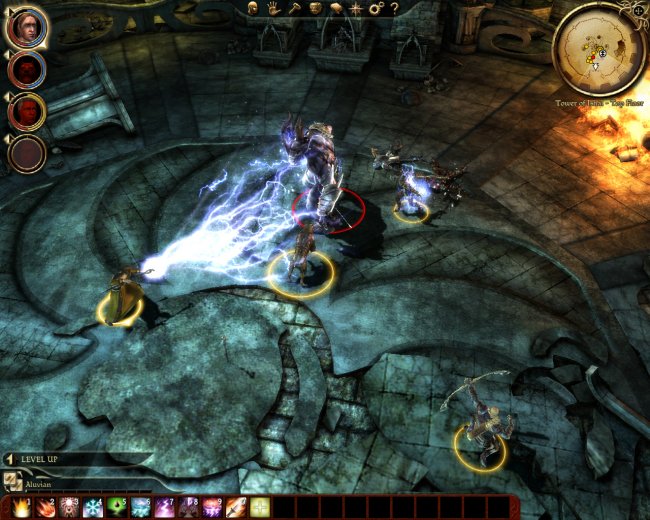
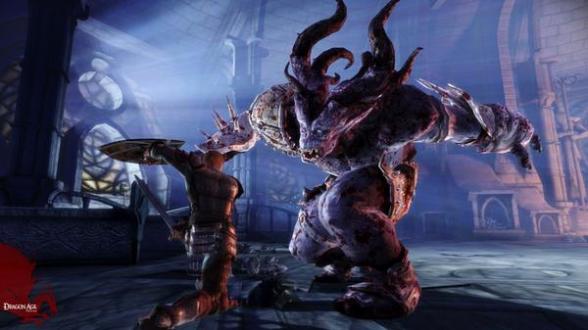
If you’ve played “Knights of the Old Republic” or “Neverwinter Nights 2,” you’ll feel right at home here. Bioware’s classic under-the-hood turn based combat system makes a glorious return in “Dragon Age.” Combat is visceral and well-animated; you can pause at any time during play to issue commands or just to catch a breather – something you’ll find yourself wanting to do often as the difficulty ramps up. Battles against particularly challenging foes often culminate in deliciously satisfying finishing moves. After finally bringing down an ogre near the beginning of the game (a feat that took many, many attempts), my dual-wielding rogue made all the effort worth it by leaping onto the falling beast’s chest in slow-motion, using her daggers to scale his bulk, and finishing the kill with a blade through the face. Just about every battle in the game is a challenge, which adds greatly the atmosphere of desperate struggle.
Graphically, the game isn’t all that special. Characters and equipment are, by and large, meticulously detailed and stand up brilliantly to zoomed-in scrutiny. The game world and environments take a hit for this, though, as there are few that will take your breath away.
Gameplay, however, is as tight as a drum. The combat is smooth and, aside from a few AI issues, flawless. Exploration is intuitive and rewarding. Leveling makes real differences in your character’s power level.
A tale of dragons
In the game’s history, each time a Blight spilled across the lands, the Gray Wardens rose to meet its devastating tide, and each time the darkspawn broke against them like waves on unforgiving rocks. You are one of the few remaining Gray Wardens, and it is your task to build up an army powerful enough to meet their threat.
Along the way you’ll gather a party of characters. Each character has a full and complex back-story, complete with hopes and dreams, deep dark secrets, and even personal preferences in regards the various gifts you can find and offer them. You can choose to interact with each character and grow closer to each one, finding out more about them and increasing their level of trust in you. Alternatively, you can treat them like dirt and spurn their every suggestion. Or you can ignore them. It’s up to you.
The only complaint about the story is a small thing: the main quest tends to get lost in the quests leading up to it. Dealing with an abomination outbreak in the Circle Tower or stopping a werewolf plague in the Bracilian forest just seems more immediate and more fleshed out than the task of stopping the Blight ever becomes. So much time and effort goes into building your army and gathering allies, the final battle ends up feeling more like an afterthought. And, without spoilers, I must stand before you and say that final battle is a rather major anticlimax. At least it ties up loose ends and doesn’t demand a sequel (though I hope that there is one).

Content concerns
On the content side, there are some issues. Religion plays a prominent role in the game – the Imperial Chantry with its revered mothers and lay priests clearly draws heavily from Roman Catholic and Islamic influences. While the player is never forced to pay fealty to a deity or worship in any way, there really isn’t any getting away from it in-game.
That said, it fits with the game’s fiction, and in my play-through I never noticed direct attacks on Christianity or any religion. There are themes throughout that alert gamers will pick up on (all truth is essentially equal; all roads lead to heaven; if it feels good, do it; etc.). While it would not be wise to play the game with one’s brain turned off, most of these issues can be navigated with a little thought and previous conviction.
Language pops up now and again, but never at any serious level – a refreshing change from the direction that many so-called “mature” games are taking these days. Alcohol and drug abuse also make appearances, but not in graphic ways.
Sexual content is perhaps the game’s biggest red flag. In a few places, characters appear rather scantily clad. The worst offender is Morrigan, a shape-shifting mage who will join your party early in the game. Her default outfit is a bit on the revealing side, to put it mildly. Attempts to alter her attire are thwarted by the fact that the most powerful equipment available to her is of the same category of revealingness. It could be argued that the getup fits with her character (she was raised in isolation from society, and she’s something of a seductress), but in my opinion it largely distracts from much more interesting facets of her persona.
A few non-human (but distinctly human-esque) female enemies appear topless with only a bit of their modesty saved by curiously inflexible locks of hair. The ability to be become sexually involved with a select few of your party members is also there. It’s entirely optional, doesn’t cross a PG-13 level of explicitness, and one character, to his credit, treats the act as something more sacred than a kiss. But the overall feeling the game gives is that it’s just a natural part of every casual romance. The cheapening effect this has on the relationships you develop with these characters is apparent.
As for violent content, there’s an odd mix here. Blood plays a prominent role in everything about this game. Gouts of it erupt during battle, it stains many of the game’s menus, and characters will be spattered in it after even the mildest of violent confrontations. Even the game’s signature logo dragon is made of blood. In spite of this, however, the violence is otherwise largely non-graphic. Other than the occasional decapitation, there are no gaping wounds or realistic blood-letting. I suspect Bioware choose this platelet-coated direction to add to their supposed theme of “dark fantasy,” but in reality it’s just kind of ridiculous.

In climactic conclusion…
In the end, the game largely overcomes its flaws and objections. There’s a great story told here, one that touches on themes of self-sacrifice, redemption, forgiveness, love, faith, justice, and a myriad of other encouraging concepts. It’ll also give you your money’s worth – while I didn’t keep track of time as strictly as I should have, my first play-through was at least 100 hours long, and I left a decent amount of content unfinished. There are two DLCs available at the time of publication, with one more on the way. Both are extremely well done and add significantly to the game – well worth their price if you don’t happen to get a version of the game that includes them.
Dragon Age: Origins is definitely one of the best games of the year; perhaps the best, period. The gameplay is engaging and polished to a fine sheen; the story is an epic page-turner; and while there are content concerns, for the mature adult gamer these are relatively minor, especially in the face of the positive themes the game espouses. I completely recommend it, and would love to hear your own experiences with the game. Leave a comment, let me know how it went down for you.
Jerod Jarvis is an independent gaming journalist and founder of Duality Games. He maintains gaming columns for The Washington Times Communities and for The Outpost. When not blogging madly about games, he freelances for the Spokesman-Review in his hometown of Spokane, Washington and attends school at Whitworth University. Check out his presence on Facebook and Twitter to stay up on Duality Games updates and the inside scoop on the gaming news you care about.







 The Blog of Jerod