
BOOM.
Smoke rolls like dark clouds over the battlefield as thunderclap shock waves slap into my chest. Roaring cannons buck as a team of artillery men rush to reload their charge. The sound of gunfire crack through the air, each musket accompanied by a tongue of flame. Officers bellow at their men, trying to keep them in line.
The Confederate army slowly advances across the contested ground, stopping only briefly to return fire in the face of the Union line. Squadrons of cavalry from both armies dart and weave between and behind the lines, wreaking havoc on the enemy’s flanks.
The cries of the wounded, the shouts of the combatants, the clash of brother against brother; crouching on the sidelines of the battle, I catch myself believing, for just a moment, that it was all real.
And to the people out there on the field, it is.
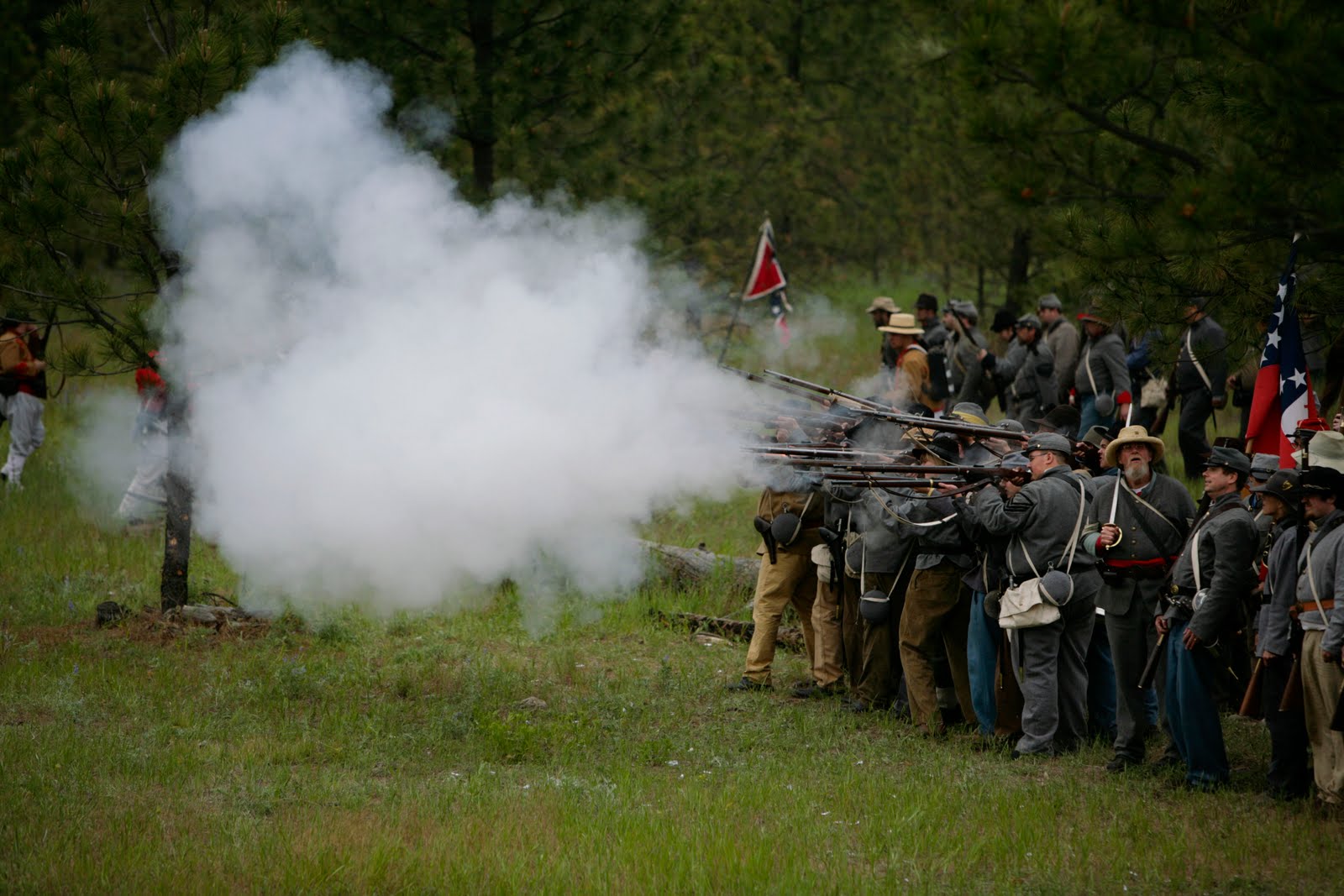
The Washington Civil War Association is holding their annual Battle of Spokane Falls in Spokane, Washington. Though no actual battle of the Civil War was ever fought in this area, Riverside State Park is a perfect location for an escape back through the decades, with its abundant pine forests out of sight of modern development.
Over two hundred reenactors are gathered here, split roughly in two between the Union and Confederate armies. The battles recreation is the main event, the part of the festivities that most attracts the public. But for the actors, the fantasy extends far beyond the field of honor.
When my intrepid photographer, Taylor Zajicek, and I first arrive, we wander into the camp and ask a friendly-looking confederate officer where we might find Jim Vaughn, the organizer for the event.

“Jim is up in the U.S.,” he said, speaking as if he’d never been to that place and hopefully never would. We’re not in Kansas anymore, I think to myself. After all, Kansas was a Union state.
“Take this road up, keep right and it’ll take you straight into union territory,” the officer told us. He was very friendly, but something about his tone made it clear that he didn’t entirely approve of “union territory.” Taylor buys some hard tack in the Company K general store, and we set out to find Mr. Vaughn.
Hard tack is every bit as nasty as Laura Ingalls Wilder claimed it was. It’s not exactly a gift of Galadriel.
Walking through the camp is like walking into a history book. Everything in sight is authentic. Tents, cookware, furniture, clothing, weapons. Especially the weapons. Most are recreations of Civil War era guns, but there are a few well preserved authentics floating around. Every gun will fire real bullets if loaded to do so; they use blanks for the staged battles.

Soldiers stand or sit in small groups, chatting and cleaning weapons. There’s a battle planned in about an hour, so preparations are well underway.
We find Jim standing underneath a small awning that protects his desk and gear from the rain that had been falling intermittently throughout the day. He is dressed to the nines, from his cracked leather boots to his faded brass buckles to his carefully cropped facial hair. He stands just shy of six feet, gloves tucked tastefully into a broad belt near the holster that holds his revolver.
After he greets us, he gives us an overview of the event and gives us a warning: there are a few folks present that are “still fighting the war”. That’s not something that I had considered as a possibility – the war never really made it up to the Pacific Northwest; the idea that there might be people here still hanging onto old grudges seems unbelievable. But I suppose we can’t all live in the present.
Not that you’d want to here. One soldier stops to talk with us, quiet passion for his hobby leaking out from behind his stubble-decorated smile as he told us that time travel is what brings him back again and again.
“Every now and again you’ll just be walking along and you’ll see something that will just transport you back to 1863,” he said, hands on the hips of his faded blue trousers. “You’ll see people sitting around the campfire, singing a song, and just for an instant … you’re there.”

It’s easy to see what he means, and even easier to understand the intoxication of that feeling.
And it’s not a difficult sensation to stumble across. Everyone here is dedicated to their part; most are amateur historians who have done years of research on the their military unit and the character they roleplay for the weekend. This is readily obvious in the attention to detail that goes into costume, gear and living arrangements.
The exception is the actors who stay in the modern camping area for the weekend. These less-dedicated souls, who apparently don’t have their priorities quite straight, bring modern tents and even RVs up to “camp” a fair distance away from their more historically correct counterparts.
Needless to say, Taylor and I erect our tent as far away from these types as we could without seeming openly snobbish.
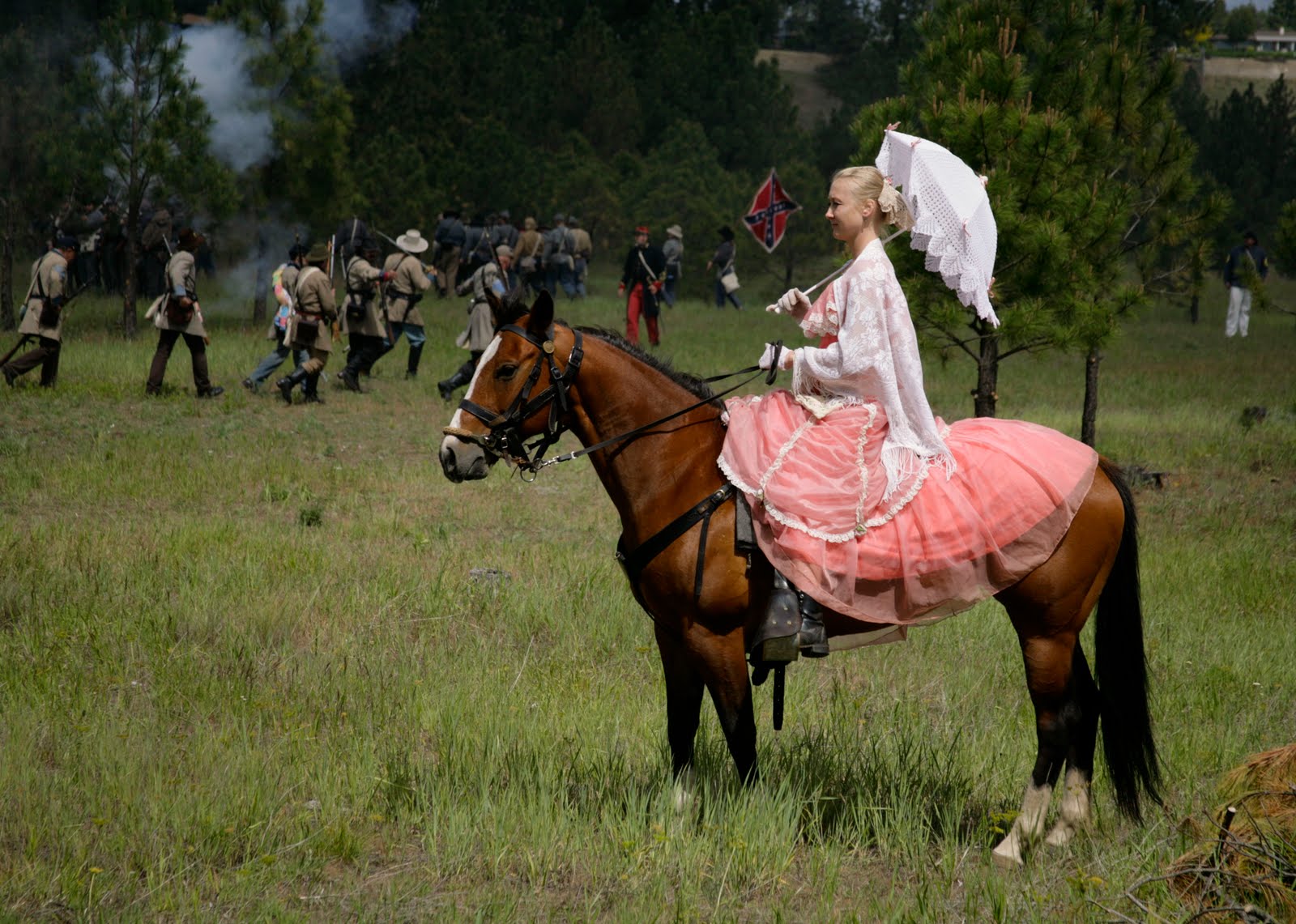 We wandered around the camp for a while, stopping to chat with the actors. Each unit is it’s own local club of sorts, often made up of friends and family members. Many of the units are based on actual Civil War units, and many of the actors have chosen an actual Civil War soldier to roleplay.
The 1st Michigan Artillery is responsible for the Union Army’s cannons. Their leader, a man in his sixties with picturesque salt-and-pepper mutton chops, is a machinist who makes the cannons himself. They are fully functional, certified by both the state of Washington and the WCWA for use in reenactments. They take nearly a year to produce and cost ten to fifteen thousand dollars apiece. When they go off, the shockwave can be felt from the other side of the camp.
Around dinner time we walk over to the confederate camp. The difference in aura is palpable, if undefinable. Perhaps it is the stigma of what those men fought for. Perhaps it’s the hindsight that tells us they are all doomed. Whatever the case, something about the camp makes us reluctant to enter. Most of the troops are enjoying an evening meal so we let them be.
We return late the next day to brave the confederate camp, and end up having pleasant conversations with the confederate cavalry. Maybe we were imagining things the day before. Or maybe cavalry are just more welcoming by nature.
Leaving the confederate camp, we make a late night visit to the campsite of a Union naval unit, complete with a landship rigged in the grassy area outside their tent. Apparently, landships were (and are) a real thing, used to maintain naval traditions and discipline among shore parties. The two men sitting around the campfire are in their seventies, bearded and talkative. In the half-light of the flickering fire, surrounded by the sights and sounds of the Union camp, staring at these old men in their uniforms talking about the Civil War, I have to remind myself that we are still in the 21st century, and that these men are talking about their great-grandparents, not themselves.
One of them claims that his great grandfather was a general in the Union army, and had been the one that talked President Lincoln out of executing Robert E. Lee for treason. It’s probably true that if Lincoln had been inclined to such a course of action, it would have split the country a second time. This man speaks with easy pride of his ancestor, the man who saved America from a second Civil War.

True story? Impossible to say. Stories have a habit of growing in grandeur with each generation that tells them. But it’s stories like his that make the trip worth it.
As we break down our tent the next day and drive out of the camp, a mix of emotions stirs inside me. I can’t help feeling that I am leaving a special place, an almost magical place. A place that, for one weekend out of the year, steps out of stride with the march of time and rolls back for a look at the way things used to be.
 The Blog of Jerod
Nice work, by both of you.