
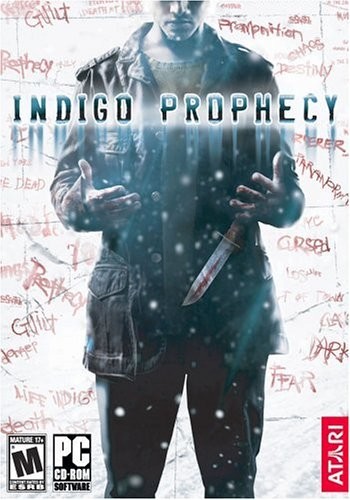
Indigo Prophecy is difficult to classify. It’s part adventure game, part action game, part murder mystery flick, with mild platforming and FPSing thrown in for good measure.
And I thought there weren’t any surprises left for me in the gaming world.
There are a great many things to like about Indigo Prophecy. First and foremost, this game tells a story. Gameplay, visuals, and all the other elements that go into making a video game serve to move the story forward. It’s an emphasis rarely seen in the gaming world.
The developer, Quantic Dream, is now following up this effort with the PS3 exclusive Heavy Rain, which looks like it’ll be a technical masterpiece, if fraught with content issues.
Throughout the game, you’ll play as one of three characters: Lucas Kane, a man framed for a murder he didn’t commit; Carla Valenti, a dedicated homicide detective; and Tyler Miles, Carla’s gangster-turned-cop partner.
The story begins with Lucas committing the murder. I know, I just said that he didn’t commit it. But he did. Then again, he didn’t. Admittedly, it’s complicated. And a bit of a head trip. But the game weaves an intricate and intriguing tale that touches on all kinds of themes, leaving a lasting impression. I haven’t been so affected by a game’s story in quite some time.
This is a game with a kind of pacing normally found only in movies (which isn’t surprising, since lead developer David Cage is committed to the idea that games and movies are essentially the same thing). There are entire sequences with zero action, plot points, or puzzles to solve.
In one particularly memorable scene toward the middle of the game while playing as Lucas, you find yourself in his apartment after a particularly stressful day trying to calm his nerves. You have him pick up his guitar and play it. The game uses on-screen cues that are a bit reminiscent of Dance Dance Revolution (though not nearly that lame) to give the player the feeling that he is involved with Lucas as he strums out the song. There’s no real reason for doing this other than to connect with the character – the player could just as easily send Lucas to bed and move on to the next scene. It’s an emotional and strikingly human moment that brought a smile to my face.
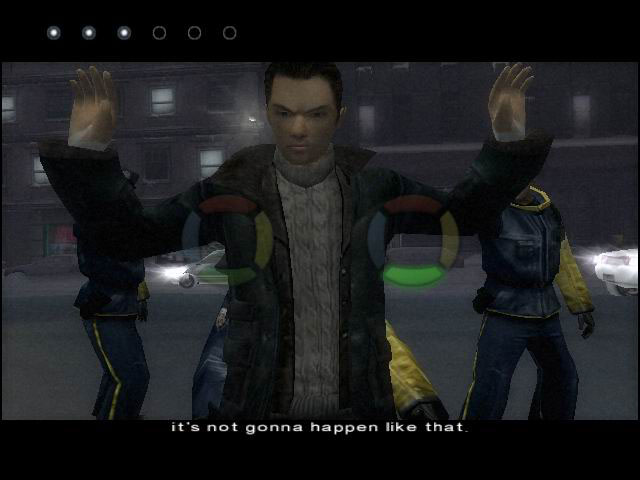
The same DDR-style on-screen cues are used throughout the game to involve you in what would otherwise be passive cut-scenes. When you get into a fight, you’ll have to follow the sequence of cues in the correct order to succeed. Sometimes failure results in death, and other times in missed opportunities.
The game does a fantastic job of wrapping you up in its world and involving you in the story. However, after finishing the game, I’m not entirely convinced it’s worth it.
There are a variety of issues. First and most easily identified is the sexual content. In the North American version of the game, most of this was censored out (the game is called Fahrenheit in other regions and contains the censored content). There’s still enough of it in the game to give me pause, however. There are two sex scenes in the game — one occurs completely off-screen, with only the audible portion of the act to titillate the player; in the second, a moment or two of sexual motion is visible before the scene fades to black.
There are a few other areas of sexual content, but none of it exceeds a PG-13 level. On the other hand, however, none of it is really justified in any way. On-screen sexual content is rarely, if ever, necessary to a story (in any medium). What sexual content there is in Indigo Prophecy is there merely for titillation, in an apparent grasp for superficial maturity. It’s a cheap attempt at sensualization that doesn’t belong in a game that is quite deep and honest otherwise.
The other major area of concern deals more directly with the story itself. Spoilers follow.

Lucas Kane did commit murder, but not of his own volition; he was the unwitting proxy of a mysterious figure known as The Oracle. Turns out The Oracle is working for a group of people called the Orange Clan, who are the last surviving tribe of Mayans. The Orange Clan feels a bit like the Illuminati, and its members have been waiting for centuries for the Indigo Child — a pure being — to be born. The Oracle is their bloodhound, and to find the Indigo Child he must perform human sacrifices — only he can’t actually perform them himself, hence the use of a proxy. The sacrifice opens a window to the other world where he can locate the child.
It also turns out that Lucas is blessed by something called the Chroma, which is apparently the Mayan’s version of the Force. It allows him to survive his proxy experience and then gives him superpowers.
So already we have weird spirituality, possession, a pseudo-Christ figure, and the Mayan version of the afterlife given credence. Not necessarily deal-breakers for someone who has their head screwed on straight. But wait … there’s more.
Lucas is a decent chap who willingly puts himself in danger to help those he loves. That’s good. But this admirable trait eventually leads to his death. Oddly enough, that’s not the end of his story.
Through methods that aren’t quite explained, the Purple Clan (who are apparently digital or something … that was never really made clear) brings Lucas back to life. Or, more accurately, undeath. He doesn’t breathe, his flesh is cold, but he moves and talks like a normal person. The Purple Clan did this so that Lucas could stop the Orange Clan from claiming the Indigo Child.
Bringing people back from the dead brings up all kinds of theological issues. Too many to list effectively here. Suffice it to say that the game offers no satisfying explanation for Lucas’ return to life, no discussion of the soul, and no justification for the idea that the dead can just be popped right back up from their graves.
Oh, and the second sex scene involves Lucas while in this undead state. Which is just … creepy. On a lot of levels.
I can hear people asking my why I don’t have a real problem with games like Left 4 Dead. It has undead, too, after all.
The difference is that Left 4 Dead and most other zombie games aren’t making any kind of real statement about life and death. They’re popcorn games. Where those games are all about running around screaming “AAAAHHHZOMBIESFTW!”, this game is more thought provoking, and draws on some real assumptions about the way the world works.
I’m not suggesting that David Cage believes in Mayan spirituality. But it’s quite obvious he doesn’t buy into Christianity, either. The game would look different if he did.
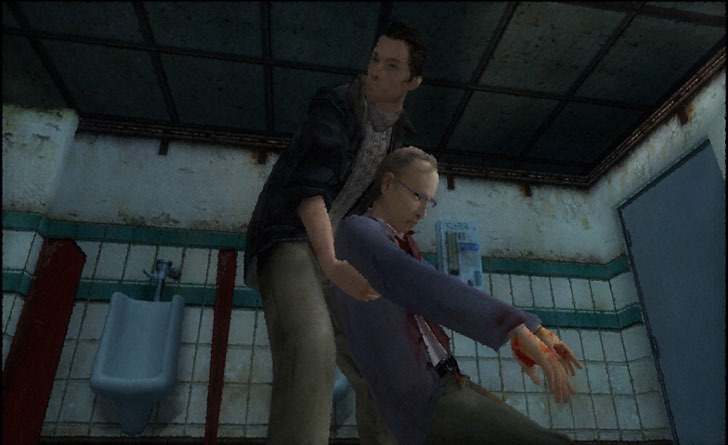
Other issues include graphic violence that manages to be disturbing in spite of dated graphics and a spattering of language.
Indigo Prophecy hits a lot of nails on their heads. It tells a compelling story in a compelling way. But it strays into some pretty iffy territory, and runs roughshod over the Christian worldview while doing so.
So, unfortunately, there’s just not enough redeeming value to give this game the nod. You’ll have to satisfy yourselves playing Evil Genius while I track down another classic game that’s worth giving a whirl.
Jerod Jarvis is an independent gaming journalist and founder of Duality Games. He maintains gaming columns for The Washington Times Communities and for The Outpost. When not blogging madly about games, he freelances for the Spokesman-Review in his hometown of Spokane, Washington and attends school at Whitworth University. Check out his presence on Facebook and Twitter to stay up on Duality Games updates and the inside scoop on the gaming news you care about.
 The Blog of Jerod