Dust rises in swirling cyclones, whisping over the hot desert. A man in a black hat surveys the horizon, his sweat-beaded face rough with stubble and pinched in gritty grittishness. His horse nibbles a cactus in the background and his spurs jingle in cliché harmony with his every step.
If John Wayne’s face didn’t pop into your head at least once while reading that paragraph, you should see a counselor before your case of epic fail gets any worse. (If you don’t know who John Wayne is, you are permanently banned from the cool crowd. Turn in your card and give back the T-shirt.) The Old West is one of Hollywood’s favorite settings, but gamers haven’t been given many opportunities to lend their uber-micro skillz to the winning of the wild frontier. The reasons for this are undefined. It could be that gaming’s traditionally weak storytelling habits don’t jive well with the sweeping ballads that westerns are known for. It could be that rendering the miles of wild west landscape was a challenge on older hardware. It could be that game developers are mostly nerds who are more into sci-fi than westerns. Whatever the case, the old L-Mouse Button (or one of those analog stick thingies if you’re a failbot) has seen more use as the trigger of a laser rifle than that of a six-shooter.
And so it was with curious anticipation that I fired up Call of Juarez. The game came out a year or three ago, but I had avoided it at the time out of concern over content issues (more on that later). Steam was running a special (that’s the story behind a lot of my games these days…) where Call of Juarez came free with the pre-purchase of its sequel, Bound in Blood, so with intention to review both games I sent my cash on its merry way.
The game is an odd mix of brilliant vision and storytelling mixed with strange design decisions and irritating bugs. While there are stretches of the game that flow well and provide a great deal of enjoyment, there are quite a few areas where the game’s issues rear their heads to sully the experience.
There are a few things the game gets dead on. The musical score is perfect – I don’t often talk about music in my reviews because the truth is that often the best game music blends in and goes unnoticed. Here, however, it sets the western tone with excellence.
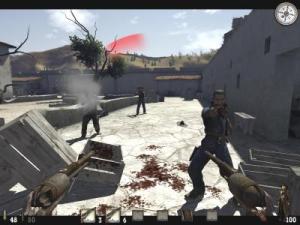
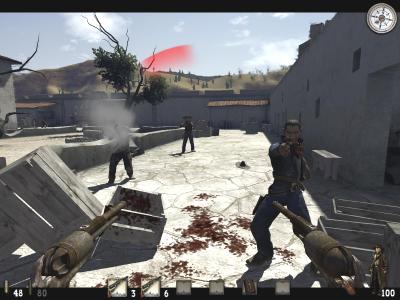
Gunfights are also done well, despite the fact they are home to a few of the issues as well. The game’s firefights are crafted to give the feel of the epic shootouts you might expect from an Eastwood flick, and they succeed more often than not. The satisfying variety of weaponry available helps keep the action fresh and interesting. Cover is a necessity and quick reflexes are critical. Chaos erupts as the bullets begin flying and bad guys throw up their hands and tumble over balcony railings as they take lead through the chest. When it all comes together, there are quite a few nail-bitingly intense gunfights that’ll leave you wanting to blow the smoke from your pistol barrel before twirling it back into the holster. Just don’t play on hard. When I first started the game I set the difficulty to its highest setting and proceeded to spend two frustrating hours trying to get through an area that took me twenty minutes tops at medium difficulty.
There are also a few set piece fights in the game, including areas where you can use a Gatling gun and even a cannon, and also a few one-on-one quick draw matches. None of these succeed quite as well as the rest of the combat at creating believable intensity, but they offer a bit of variety that can be refreshing.
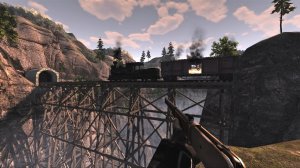
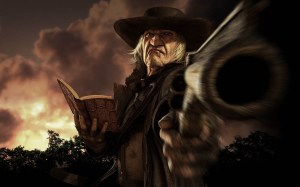
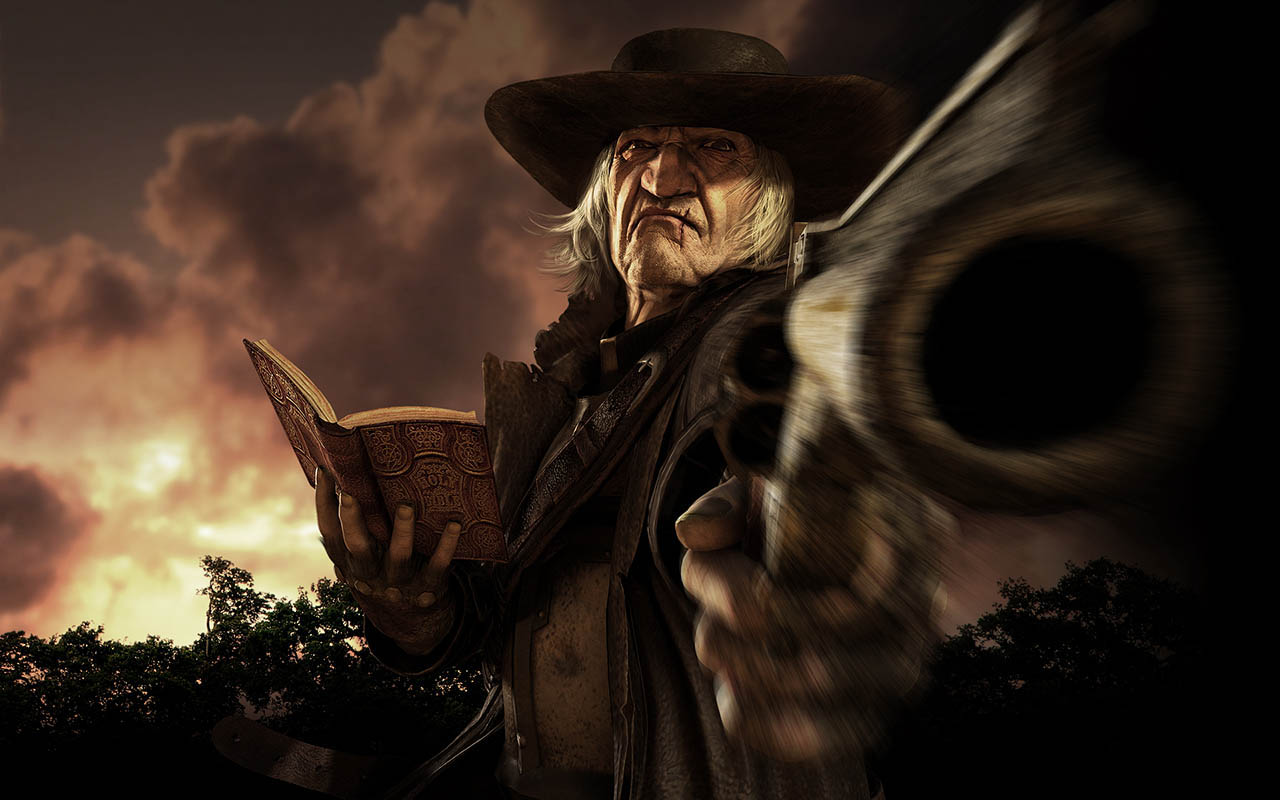
The story, however, is hands down the game’s best accomplishment. You’ll play two characters: Billy, a child whom trouble seems to follow in spite of his best efforts to outrun it, and Reverend Ray, a fire and brimstone preacher who happens to be Billy’s uncle. As you progress through the game you’ll alternate between Billy and Ray. Billy will sneak through an area, using cover and lots of quick saves to get through enemy-infested areas without being seen. Ray will then come through, kicking stealth in the teeth as his six shooters deal out death to anybody foolish enough to shoot back. This pattern isn’t universal enough to become monotonous, and serves its story-driving purpose quite well.
The game opens with Billy returning home after spending a few years out on his own. Soon after arriving, Ray catches Billy with the bodies of Billy’s mother and step-father (Ray’s brother). Billy runs, and Ray vows to bring the wrath of God to him by any means necessary.
It’s a simple premise, but it’s executed well, mostly through the intriguing development of the characters. Ray in particular is a fascinating character to play. It’s made clear that his life before donning the cloth wasn’t altogether on the right side of the law, and his struggle to understand God’s will is given enough weight to make it a genuine story of a man’s search for meaning and purpose.
There are a few issues to keep in mind. The nature of Ray’s spiritual journey means that for most of the game he’s dealing death liberally all in the name of ‘bringing God’s justice to the sinner.’ He believes himself to be the sword of the lord, and it isn’t until late in the game that he realizes that perhaps he has misinterpreted what God wants.
The spiritual struggle isn’t resolved quite as satisfactorily or explored as deeply as it should have been. While I was pleasantly surprised it wasn’t treated with the ham-handed disdain religion receives in a lot of productions, I finished the game wishing there had been a bit more resolution.
There are a few other content concerns. Foul language comes with a fair amount of frequency, though the most offensive words are rare. Bandits can be overheard discussing various topics around their campfires, many of which are of a sexual nature, and there is one scene near the beginning in which a bar girl starts to disrobe Billy and comments on his ‘family jewels.’ This awkward scene is cut short before it gets any worse, and there isn’t any nudity shown, but it’s enough of a step over the line to warrant concern.
Certainly the most pervasive content issue is violence. This is an M-rated game, but while the body count is quite high, the violence is relatively tame. Most bad guys go down with minimal blood, and the game doesn’t allow the harming of innocent civilians or animals.
Aside from content issues, the game’s design is quite rigidly linear, almost to the point of being arcade-like at times. Bad guys pop up from hidden spawn points like a cowboy version of Area 51, and there is rarely more than one possible path forward. Most irritatingly, the game frequently pops in with tutorial-like prompts throughout the game. The first time a bad guy challenges you to a duel, it’s helpful to know how to go about filling him full of holes. The fourth or fifth time, however, the aid just disrupts the flow and ruins the suspension of disbelief.
While none of these issues are bad enough to ruin the overall experience, they do prevent the game from achieving ‘classic’ status. Some players may appreciate the linear nature of the game. If you enjoyed Call of Duty 4’s overall design philosophy, you’ll probably like Call of Juarez, too, though it admittedly isn’t nearly as polished.
In the end, Call of Juarez manages to be an enjoyable game in spite of some irritations. I can’t wholeheartedly recommend it, however. While the story is one of redemption – and is one of the better gaming tales available on the shelves today – it takes enough detours into ‘hope-Mom-doesn’t-see-this’ land that caution should be exercised before deciding to partake in this wild wild western adventure.
Jerod Jarvis is an independent gaming journalist and founder of Duality Games. He maintains gaming columns for The Washington Times Communities and for The Outpost. When not blogging madly about games, he freelances for the Spokesman-Review in his hometown of Spokane, Washington and attends school at Whitworth University. Check out his presence on Facebook and Twitter to stay up on Duality Games updates and the inside scoop on the gaming news you care about.



 The Blog of Jerod