
Picture it: you awake to find yourself in the bowels of a ship, the wood creaking around you, the sounds of the ocean outside. You have no idea why you’re there — only that you were released from prison without explanation and stuck on a ship to who-knows-where. There’s a dunmer, a dark elf, standing beside you, who asks your name in his gravelly voice before the guard comes and takes you away, leads you topside and kicks you off the ship.
After completing some paperwork with the local authorities, you’re set free.
And what freedom it is. From the moment you step outside the door of the census building, your future is up to you. You can follow the gentle nudges the game gives you in the direction of the main quest; you can sneak around the town of Seyda Neen and rob its citizens blind; you can head off into the wilderness and try your luck with the denizens and monsters there; you can stick to the roads and make a beeline for the massive capital city of Vivec; or just about anything else you can think of. The game puts very few restrictions on you, and those it does largely feel natural.
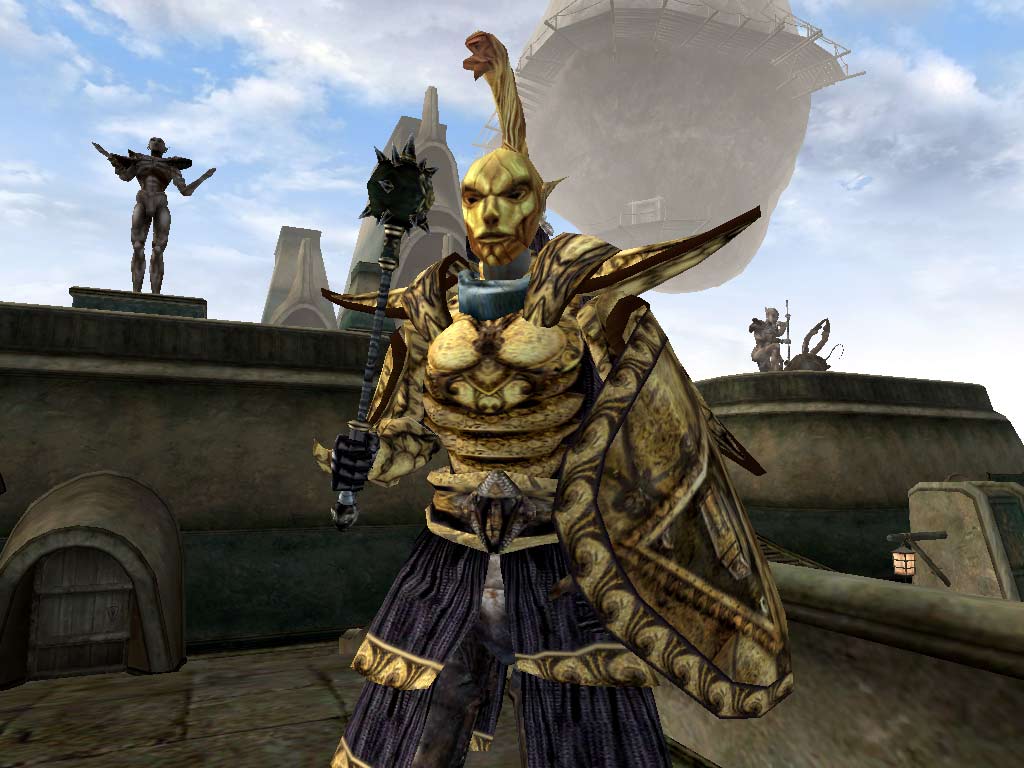 The Elder Scrolls games have always been about wide open worlds that allow you to explore at your leisure. The first two efforts were admirable in their pioneering of the genre, but were laden down with bugs and other issues. In this, the third game, the series hits its stride. With graphics that were, for the day, glorious; a truly huge gameworld to traverse; hundreds of quests and people to interact with; and an epic main quest that hands you the task of saving the world, the game was engrossing and enthralling.
The game is an RPG at heart, but it gives a unique twist to the typical D&D-spawned role-playing system. Instead of getting rewarded for every completed quest, killed monster, and picked lock with experience points (XP), the skills you use are the skills you get good at. In most RPGs, you could run around the game picking every lock you find but never getting any better at picking locks because you chose to funnel all your XP into buffing up your swordsmanship. In Morrowind, using your lock-picking skill improves your lock-picking skills, and using your sword improves your swordsmanship. It’s a far more intuitive way to go about character development, and it’s difficult to be satisfied with the old way of doing things after playing Morrowind.
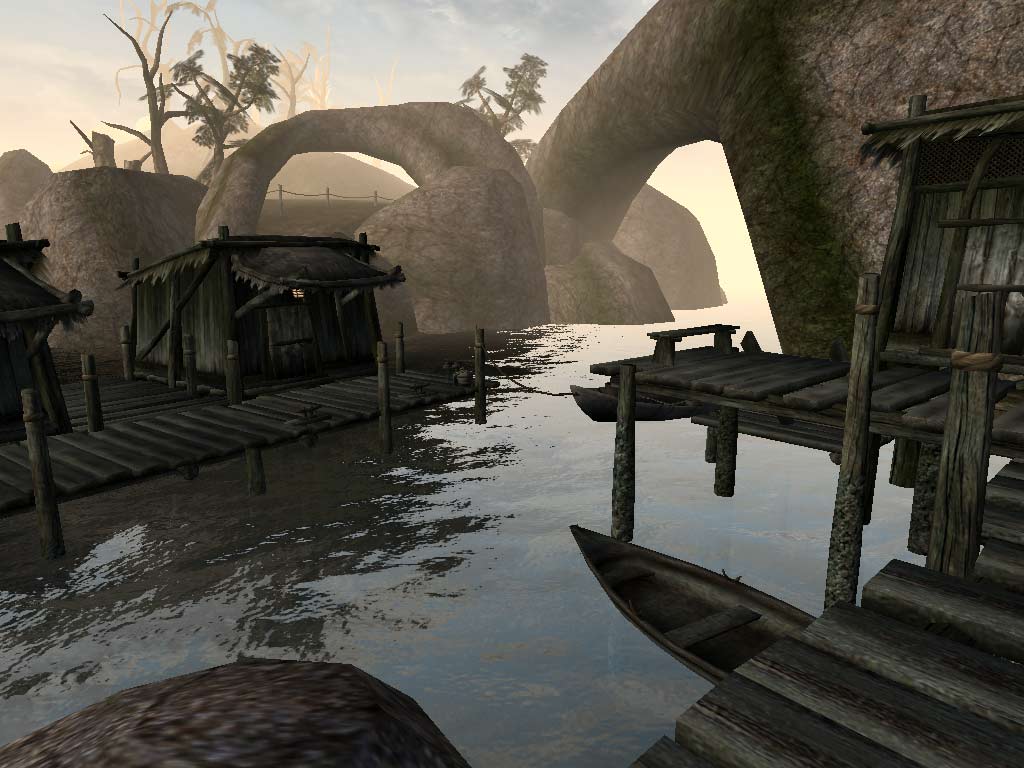 Morrowind was originally released in 2002, and was followed by various patches and two expansion packs, both of which are extremely well done and entertaining.
However, in spite of all I have told you, you may still be wondering what exactly makes this game a classic. After all, there have been many games with innovative gameplay and an epic story that, while being duly noted as excellent games, can’t be found for sale anywhere and whose memory has faded from gamers’ minds. So what is it that separates Morrowind from the pack?
The true genius of the game lies in two areas. First, the back-story of the game — the world of the Elder Scrolls is fleshed out enough to be a real place. It has a fully worked out world, with nations, oceans, seasons, constellations, history, religions, races, wars, rivalries, and everything else you’d expect to find in a real place. Wikipedia has dozens and dozens of pages written by fans detailing the ins and outs of all this, which can make for a bit of daunting reading for a newcomer.
Outside of the first 10 minutes of character creation, nowhere does the game ever admit that you’re playing a game — the immersion of being in a real place affecting real things is very near complete. It even has its own supernatural realm of sorts, in which gods and demons live. At first glance that element might make some Christian gamers wary, but a bit of research reveals that the game doesn’t truly deal with the supernatural — the ‘gods’ are merely powerful creatures that live on different planes of existence, more like the gods of Greek mythology than the God of the Bible. It doesn’t directly address real world issues of God in any way. This makes it very playable for the gamers who have their heads on their shoulders.
The second area of genius applies only to the PC version of the game (sorry, Xboxians). The game shipped with a Construction Set, a slightly modified set of tools that Bethesda used to build the game. With these tools, nearly anything imaginable was possible to add to the game. Want a house deep in the Red Mountain? Fire up the construction set and build yourself one. Want a sword that does one thousand stabbing damage but only one slashing damage? Easy. Fancy yourself a rock star with adoring fans following you wherever you go? With a bit of scripting knowledge, it’s done in a flash. Mods that update the graphics, add enemies, weapons, and quests, allow you to wear more rings and necklaces, flesh out the back-story of a particular person that was passed over in the original game — almost anything that’s in the game can be modified, expanded, or completely removed, and nearly anything that can be dreamed up can be added in. My copy of Morrowind is currently running something like fifty mods, three or four of which are my own.
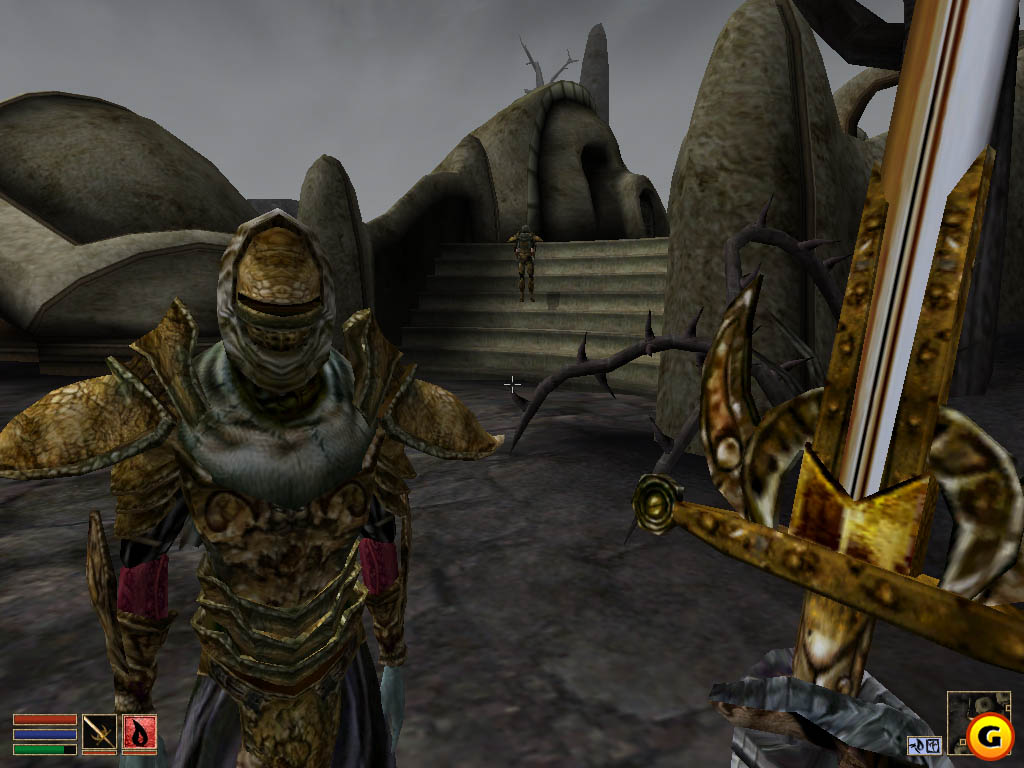 The modding community is extremely helpful on the creation side. Need help with a challenging script? First check out one of the three or four huge fan-made tutorials on the subject. If you can’t find your answer there, get thyself to the Elder Scrolls forums and ask. Usually within 24 hours you’ll have an answer.
The back-story of the game and its fleshed-out world gave fuel to the imaginations of games, and the Construction Set gave outlet for those imaginations. It’s a formula that has worked wonders for Bethesda’s games.
Bottom line — this game is epic in every sense, and will almost certainly devour your life for a while. The Game of the Year edition, which includes both expansion packs, can be found on the shelves of your local Best Buy for 20 dollars or so. Get out and buy it now, and tell me what you think.
Jerod Jarvis is an independent gaming journalist and founder of Duality Games. He maintains gaming columns for The Washington Times Communities and for The Outpost. When not blogging madly about games, he freelances for the Spokesman-Review in his hometown of Spokane, Washington and attends school at Whitworth University. Check out his presence on Facebook and Twitter to stay up on Duality Games updates and the inside scoop on the gaming news you care about.
 The Blog of Jerod
Excellent article, you might consider putting it on a “free article bank” with some screenshots, if you don’t intend to sell it. There’s no knowing where it might turn up, then. Or who might be inspired by it. You might have mentioned the third-party applications that have been made. Morrowind Graphics and Script Extenders, the mod managing applications, etc. And there’s the ‘Morroblivion’ expansion for Oblivion, and the Open Morrowind project to rebuild the game in Open Source form. As Todd, one of the game’s makers says, “cool is cool forever”. People will still be playing this game in fifty years, just as we now still read Alice in Wonderland, and the fans will give them the tools to do it in style.There’s also scholarship on the game… http://morrowind2009.wordpress.com/academic-scholarship/
Thanks for the comment. I’ll look into posting it other places. I was under the impression that Morroblivion got shut down by Bethesda…I do use the graphics and script extenders, though. Excellent stuff.
Awesome once again dude. I’ve actually recently gotten into Oblivion (via a friend). It’s pretty awesome and epic, but even with all I have played and learned, I still feel like I know nothing. I’ll have to check out some of those Wikipedia articles.Keep it up! You not only have good taste, but you write very well!
I’ll do ya a small favor and put the link to your blog on my favorite Gaming/Emulation forum.
Thanks, Jac. You rock. Definitely check out the wikipedia for Elder Scrolls–and definitely (definitely) check out http://www.planetelderscrolls.com for mods. Once you start modding stuff, your life will change forever. It is made of epic win.